Why Do We Dream? 5 Secret Part of Your Brain Doesn’t Want You to Miss
Why do we dream?
Have you ever woken up at 3 am from a dream that’s so vivid, so emotionally real, that it took you several minutes lying in the dark to accept it wasn’t actually happening?
I have. More than once.
And here’s what frustrated me more than the dream itself within an hour, it was gone. The story, the people, the feeling of absolute certainty that it was real. All that remained was a vague emotional residue, like the smell of something that has already left the room.
That’s what sent me down this rabbit hole. I wanted to understand what was actually happening in my brain when I dreamed. Not the surface answer. The real one.
What I found surprised me, not because the science was complicated, but because the honest answer is this: after more than a century of research, scientists still cannot fully explain why we dream. But what they do know is far more fascinating than any simple answer would be.
Let’s go through it together.
First, a Brief History: When Did We Start Asking This?
Humans have wondered about dreams since the beginning of recorded history. Ancient Egyptians believed dreams were messages from gods. Greeks built temples where people slept specifically to receive divine guidance in their sleep.
But actual scientific research on dreams didn’t begin until the late 19th century. In 1899, Sigmund Freud published The Interpretation of Dreams, proposing that dreams were the “royal road to the unconscious”: windows into repressed desires and hidden psychological conflicts. His work dominated dream research for decades, even though modern neuroscience has largely moved away from his interpretations.
The real turning point came in 1953. A graduate student named Eugene Aserinsky, working under sleep researcher Nathaniel Kleitman at the University of Chicago, noticed something strange while monitoring sleeping subjects that their eyes were moving rapidly beneath their closed eyelids in distinct bursts. He had discovered REM sleep. Rapid Eye Movement sleep. And when they woke subjects during these periods, nearly all of them reported vivid, story-like dreams.
For the first time, scientists had an objective, measurable marker for dreaming. Everything that followed built on that single observation.
So What Actually Is a Dream?
Here’s a simple way to think about it.
Right now, your brain is processing the world through your senses: what you see, hear, feel, and experience. It builds your sense of reality from that constant incoming information.
When you sleep, that incoming information stops. But your brain doesn’t. It keeps running. And in the absence of real sensory input, it starts generating its own visuals, sounds, stories, emotions, and experiences that feel completely real because, as far as your brain is concerned in that moment, they are.
That’s a dream. Your brain creating a fully immersive inner world from its own internal activity, with no connection to the outside world.
Dreams can be vivid in color, in black and white, or in some cases, particularly for people who have been blind or deaf since birth are composed entirely of touch, sound, emotion, and sensation without any visual component at all. Your brain works with whatever materials it has.
And while the old understanding was that dreams only happen during one specific stage of sleep called REM, newer research has found that a form of dreaming can occur at almost any stage, though the character and intensity differ dramatically depending on where you are in your sleep cycle.
Which brings us to the stages themselves.
Your Sleep Is Not One Thing: It’s a Journey
Most people think of sleep as simply being unconscious for eight hours. But your brain experiences something far more structured than that.
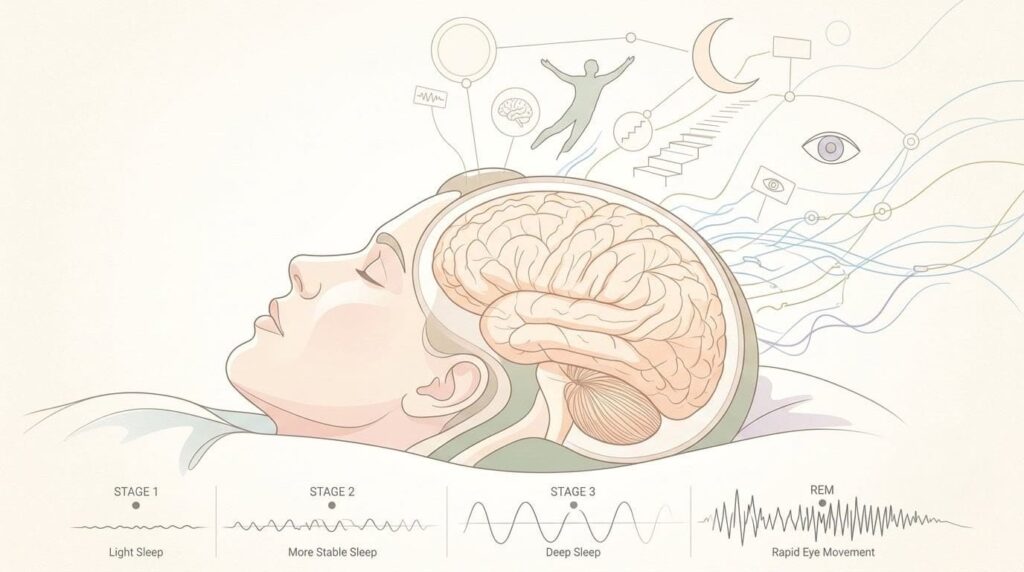
Every night your sleep moves through a repeating cycle of four distinct stages, each one different in depth, brain activity, and what your mind experiences.
Stage 1: Light Sleep (1 to 7 minutes)
This is the threshold between waking and sleeping. Your body is beginning to relax but you remain easy to wake, a door closing nearby might bring you fully back to awake. In this stage you may notice yourself seeing fragmented shapes, colors, or geometric patterns behind your eyelids. You might briefly replay sounds or images from your day. If you’ve ever jerked awake suddenly just as you were falling asleep, that’s called a hypnic jerk, and it happens almost exclusively during Stage 1.
Stage 2: Deeper Light Sleep (10 to 25 minutes)
Your body temperature drops slightly and your heart rate slows. Your awareness of the outside world fades. Brief, fragmentary dream-like experiences can occur here but they lack the narrative quality of true dreaming that’s more like disconnected thoughts than stories.
Stage 3: Deep Slow-Wave Sleep (20 to 40 minutes)
This is your body’s repair stage. Growth hormone is released. Your immune system strengthens. Your brain produces slow, synchronized waves of electrical activity. If you wake up during this stage, you feel genuinely disoriented, something like groggy, confused, unable to think clearly. Scientists call this sleep inertia. Deep slow-wave sleep is where your body heals itself physically. Dreaming here is rare and when it occurs is typically fragmented and non-emotional.
Stage 4: REM Sleep (begins after approximately 90 minutes, then repeats)
This is where dreaming lives.
REM stands for Rapid Eye Movement, it is named for the characteristic quick movement of your eyes beneath closed eyelids during this stage. Your brain activity during REM looks remarkably similar to when you’re fully awake. Your breathing becomes irregular. Your heart rate rises. Your brain is doing something intensely active.
But something remarkable happens to your body at the same time, your voluntary muscles become essentially paralyzed. Your arms, legs, and most of your body cannot move. This is called REM atonia, and it is your brain’s built-in safety mechanism. Without it, you would physically act out everything happening in your dream.
People who lose this protective paralysis have a condition called REM Sleep Behavior Disorder: they genuinely do punch, kick, shout, and act out their dreams while remaining asleep. Beyond being medically concerning, this condition gave scientists powerful early evidence that dreams are not just noise, they are genuinely experienced events that the body wants to respond to.
The first REM period of the night lasts roughly 10 minutes. But here’s something important, as the night progresses, each subsequent REM period gets longer. By your final sleep cycle before waking, REM can last 45 to 60 minutes. This is why the most vivid, emotionally complex dreams almost always happen in the last hour or two before you wake up.
Which Parts of Your Brain Are Actually Creating This?
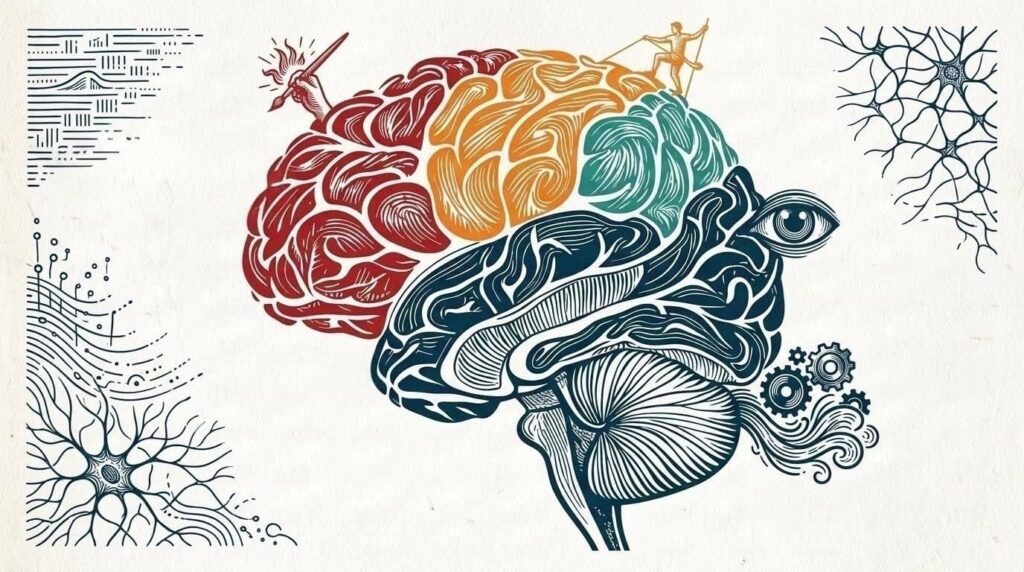
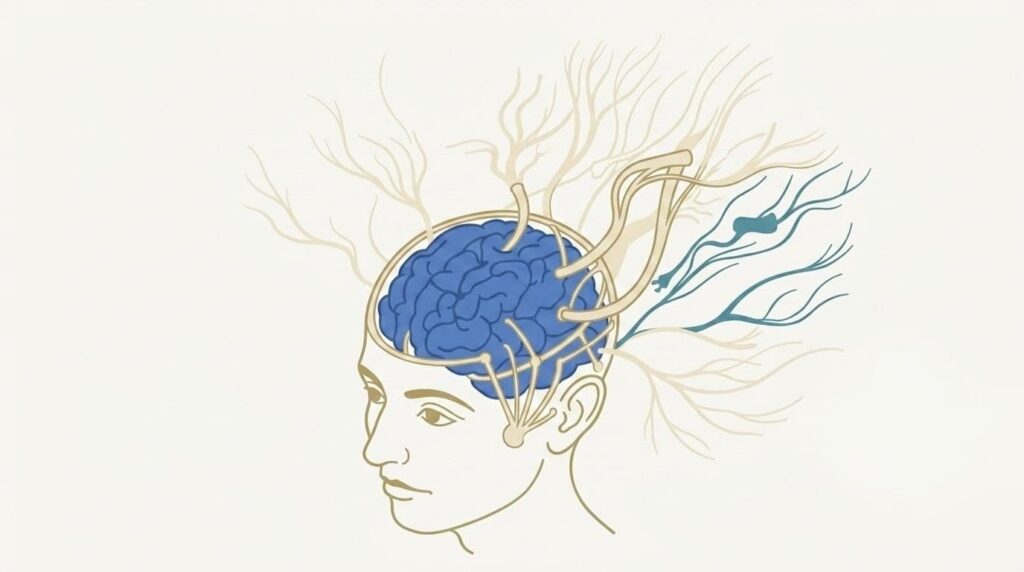
No single brain region creates dreams alone. It’s a collaboration like how lifting a heavy weight isn’t done by just your hand but by your nerves, muscles, bones, and body working together. Dreaming works the same way.
Here are the five key players:
1. The Hippocampus: Your Memory Bank
During dreaming, your hippocampus is busy pulling fragments of recent and older memories such as what happened today, what you experienced years ago and combining them in unexpected ways. It’s supplying the raw material for the dream. The people who appear, the places you visit, the situations you find yourself in, these are memory fragments being reassembled in real time.
2. The Amygdala: Your Emotional Engine
The amygdala is one of the most active brain regions during REM sleep, it is more active, in fact, than during most waking hours. It processes fear, excitement, anxiety, joy, and emotional intensity. This is why emotions in dreams don’t just feel like emotions but they feel amplified. The fear in a nightmare is processed through the same neural pathways as genuine fear. Your brain, in that moment, cannot tell the difference between a simulated threat and a real one.
3. The Visual Cortex: Your Internal Cinema
Even though your eyes are closed and receiving zero visual input, your visual cortex fires actively during REM sleep. It generates the imagery such as the people, places, colors, and movements of your dream. This is why dreaming feels like watching a movie that you’re simultaneously inside of.
4. The Default Mode Network: Your Sense of Self
The Default Mode Network, or DMN, is a newer area of research that has significantly changed how scientists understand dreaming. This network activates during daydreaming, self-reflection, imagining future scenarios, and remembering past experiences. During dreaming, the DMN stays highly active, which is why you have a sense of being yourself in the dream, of having a perspective, of existing as a character in the story your brain is telling.
5. The Prefrontal Cortex: The Part That Goes Quiet
The prefrontal cortex is responsible for logic, critical thinking, planning, and reality-checking. During REM sleep, it becomes significantly less active. This explains something you’ve probably noticed that in dreams, impossible things feel completely normal. You can fly. Rooms change shape. People become other people. Time jumps without explanation. And in the moment, none of this seems strange at all. Your logical filter is essentially switched off. The moment you wake up and it comes back online, the absurdity becomes obvious.
Why Do We Dream? The Theories Science Has Offered
This is the most important section of this article — and also the most honest one.
Scientists do not agree on why we dream. There is no single accepted theory. What exists instead are several compelling explanations that each account for part of the picture. Let’s look at all of them, because most science articles only give you one.
Theory 1: Memory Consolidation
During sleep, and particularly during REM sleep, your brain consolidates the memories of that day. Matthew Walker, a neuroscientist at UC Berkeley and author of Why We Sleep, argues that dreaming is part of how your brain integrates new information with existing memories: filing what matters, releasing what doesn’t. Studies have shown that people who sleep after learning a new skill perform measurably better the next day than those who don’t, and that REM sleep specifically appears important for this process.
But here’s the honest limitation of this theory, it explains what the brain might be doing during dreaming but not why you experience it as a story. If memory consolidation is simply a filing process, why does it feel like something? Why the narrative?
Theory 2: Threat Simulation
Finnish neuroscientist Antti Revonsuo proposed that dreaming evolved as a threat rehearsal system. In dreams, especially in nightmares, your brain practices responding to dangerous situations. It runs simulations so that when you encounter a real threat, your responses are faster and more effective. Evidence for this includes the finding that threatening events appear in dreams at a rate significantly higher than in waking life, across every culture studied.
Think of it this way, if a child dreams of being chased and manages to escape in the dream, she has practiced that response without any real danger. Evolution may have kept this simulation system because it provided survival advantages.
Theory 3: Emotional Regulation
Matthew Walker and others have proposed that REM sleep and dreaming help regulate emotional memories specifically. The theory suggests that during dreaming, your brain replays emotional experiences but in a neurochemical environment where norepinephrine, a stress-related chemical, is at its lowest point of the entire day. In this calmer chemical environment, the emotional charge of difficult memories is gradually reduced.
This is why a painful memory that feels sharp and raw in the week after it happens often feels less intense months later. Sleep and specifically REM sleep, may be doing that emotional editing work.
The implications for PTSD are significant. People with post-traumatic stress disorder frequently experience disrupted REM sleep. Walker and others believe this disruption may prevent the emotional processing that normal dreaming provides, keeping traumatic memories at full intensity rather than allowing them to heal.
Theory 4: Activation-Synthesis (The Skeptic’s View)
Psychiatrists J. Allan Hobson and Robert McCarley proposed in 1977 that dreams don’t begin with meaning at all. During sleep, the brainstem generates random electrical signals. The narrative-making parts of your brain, which are always trying to make sense of things, interpret those random signals and construct a story from them using available memories, emotions, and images.
Under this view, dreams are not messages to decode. They are your brain’s storytelling machinery trying to create order from random noise. The story it creates might be bizarre or emotionally loaded, but that’s a consequence of the randomness of the input, not evidence of hidden significance.
Why Do You Forget Almost Every Dream You Have?
You probably know this experience well. A dream that felt completely real and vivid at 3 am is, by 9 am, completely gone. Sometimes it vanishes within seconds of waking.
Here is why.
During REM sleep, a neurotransmitter called norepinephrine which plays a key role in forming lasting memories, drops to its lowest level of any point in the day. Without sufficient norepinephrine, your brain cannot effectively encode what’s happening into long-term memory. The dream is experienced intensely but leaves almost no trace.
The moment you wake up, norepinephrine levels begin rising again. This is why the dream you have right before waking: your final REM period is the one you’re most likely to remember. Your brain is already beginning its return to waking neurochemistry.
If you want to remember your dreams more consistently, there is one practical technique that actually works, keep a notebook beside your bed and write down whatever you can recall within the first 60 to 90 seconds of waking. Before you check your phone. Before you speak to anyone. Before you get up. That neurochemical window is narrow and closes quickly.

Can Animals Dream Too?
This is one of my favourite parts of the science because the answer changes how you think about what dreaming is.
Yes, animals dream.
In a landmark 2001 study, MIT neuroscientist Matthew Wilson and graduate student Kenway Louie trained rats to run a circular track for food rewards. While the rats ran, they recorded detailed patterns of activity in their hippocampus: their memory region. Then they recorded the same rats during sleep.
What they found was striking. The hippocampal patterns during REM sleep matched the patterns during the maze run almost exactly in some cases precisely enough that the researchers could identify which part of the track the rat was “running” in its dream.
Beyond rats, dogs show clear REM sleep with the characteristic eye movements and occasional twitching limbs. Cats spend a significant portion of sleep in REM cycles. Even some birds display REM-like states.
What does this tell us? That whatever function dreaming serves, it almost certainly predates human consciousness by millions of years. Dreaming is not uniquely human. It is ancient. It is deeply biological. And that suggests it serves a purpose important enough that evolution has preserved it across wildly different species.
So Why Can’t Scientists Just Figure This Out?
This is the question that bothered me most when I started researching this article and I think it deserves an honest answer.
The fundamental problem is that dreaming is entirely internal. A neuroscientist can measure your brain waves, track your eye movements, and monitor your breathing during REM sleep. But they cannot see the dream itself. The only access to dream content is your report of it and you’ve almost certainly already forgotten most of it by the time you can speak.
You cannot objectively record a dream. You cannot replay it. You cannot verify whether what someone reports they dreamed actually matches what their brain generated. This makes testing theories with real scientific rigour extraordinarily difficult.
We are essentially trying to understand a private film that erases itself seconds after playing, using only the fragmentary memories of someone who was unconscious when they watched it.
It is one of the most genuinely hard problems in all of neuroscience not because scientists aren’t capable, but because the nature of the phenomenon resists the tools science normally uses.
The Honest Conclusion: What We Actually Know
So. Why do we dream?
After everything I’ve read and everything in this article: here is the most honest answer I can give you.
We know where dreaming happens in a sleeping brain, primarily during REM sleep, generated by the collaboration of memory, emotion, imagination, and a quietened logical filter.
We know when it happens: cycling through the night, growing longer and more vivid as morning approaches.
We know what the brain is doing physically: the regions that activate, the paralysis that protects you, the neurochemistry that makes it feel real and then makes you forget.
We have four serious theories about why memory consolidation, threat rehearsal, emotional regulation, and random activation. Each one is supported by real evidence. None of them has won.
What we do not know what remains genuinely, beautifully unresolved, it is the ultimate biological purpose of the dream experience itself. Why does memory consolidation or emotional regulation require you to live through a story? Why does the brain generate a felt, immersive experience rather than simply processing in silence?
That question remains open. And I find that more interesting than a clean answer would be.
Dreams are one of the last genuinely mysterious things about being human. In an age where we can sequence entire genomes and image black holes 55 million light-years away, we still cannot fully explain why your brain spends roughly two hours every night generating a private world that feels completely real and then disappears.
The next time you wake up at 3am from a vivid dream — lie there for a moment before it fades. You are experiencing something ancient, something shared with rats and dogs and birds, something neuroscientists have studied for decades and still haven’t fully cracked.
That’s not a gap in our knowledge. That’s an invitation to stay curious.
What’s Upcoming
If this article made you wonder, can you actually control your dreams? Is it possible to know you’re dreaming while it’s happening and direct the story yourself?
The answer is yes. And the science behind it is even stranger than the dreams themselves.
Next week we’re going deep on lucid dreaming: what it is, what it reveals about consciousness, and whether there are real techniques to remember your dreams and take control of them.
Subscribe below so you don’t miss it. One science explanation, every week.
References
- https://pmc.ncbi.nlm.nih.gov/articles/PMC11623913/?utm_source=chatgpt.com#ABS1
- https://www.britannica.com/topic/dream-sleep-experience/Physiological-dream-research
- https://pmc.ncbi.nlm.nih.gov/articles/PMC3220269/
- https://www.psychologytoday.com/us/blog/dream-factory/201606/brief-history-dream-research
- https://news.mit.edu/2001/dreams-0131
- https://www.scientificamerican.com/article/why-do-we-forget-so-many-of-our-dreams1/