I Wasted 49 Days of My Dream. Here’s the 30-Minute Rule That Changes Everything
If you’ve been struggling with how to make time for your goals. I want to tell you something I’m not proud of.
I started this blog in late March with everything planned out. The categories, the vision, the name “Mind Manas” , even the feeling I wanted people to get when they read it. I was genuinely excited. I don’t know why, I felt that was my time.
Then April happened.
Then half of May happened.
And I wrote nothing. Published nothing. Built nothing.
Not because life was impossible. Not because I had zero time. But because I told myself a story every single day “I’ll start tomorrow,” “college is too intense right now,” “I need to be in the right headspace first.”
Forty-nine days disappeared. And yesterday, I sat with that. I actually cried not dramatically, but the quiet kind of crying that happens when you realize the gap between who you are and who you want to be has gotten wider, not smaller.
This post is about that gap. And more importantly what actually closes the gap.

You’re Not Lazy. You’re Caught in a Loop.
The first thing I need to say is this — if you’ve been here, in this exact place where you have a goal you care about deeply and somehow still can’t make yourself work on it, you are not broken.
But I’m sure you are caught in something.
Psychologists call it the intention-action gap the very real, very studied distance between what we genuinely want to do and what we actually do. A 2001 study published in the British Journal of Health Psychology by Peter Gollwitzer found that up to 94% of people fail to act on their intentions without a specific implementation plan, not because they don’t want it badly enough, but because wanting something and planning when, where, and how to do it are two completely different mental processes.
I wanted to build this blog. That was real. But I never decided when I would write. I never blocked time. I just hoped motivation would show up like a guest who doesn’t need an invitation.
It didn’t.
What I Was Actually Doing With My Time
Here’s the honest version of my April and half of May.
I wasn’t studying 14 hours a day. I wasn’t running some other project. I was doing what most of us do, filling time with things that feel like rest but are actually just noise. Scrolling. Watching. Drifting from one distraction to the next while telling myself I was tired and deserved this.
And I did deserve rest. That part wasn’t wrong.
What was wrong was that I never chose rest intentionally. I just fell into it. And there’s a massive difference between choosing to rest and falling into avoidance.
A 2019 study from the University of Nottingham found that self-compassion and procrastination are deeply linked people who can’t forgive themselves for past failures procrastinate more on future tasks because starting something new means risking another failure. So the longer I avoided the blog, the harder it became to open my laptop and write.
The guilt of not starting was literally making it harder to start.
Sound familiar?
The Myth of “Finding Time”
I kept waiting to find time. As if somewhere between my morning college and midnight scrolling, a clean, uninterrupted 2-hour window was going to reveal itself and say “Here I am. Write now.”
That window never came. It never comes. Not in college. Not in a 9-to-5. Not as a parent. Not ever.
Time is not found. It is made. And it is made in small, unsexy increments.
Here’s what the research says about this. A 2014 study published in the Journal of Consumer Psychology found that people dramatically overestimate how much time they need to make meaningful progress on a goal. We think we need large blocks of 2 hours, a free weekend, a holiday when in reality, consistent small sessions outperform occasional long ones both in output quality and in building the identity of someone who does the work.
James Clear, in Atomic Habits, puts it simply: you don’t rise to the level of your goals, you fall to the level of your systems.
I had a goal. I had a zero system.
What 30 Minutes Actually Does to Your Brain
I used to think 30 minutes wasn’t worth it. What can you really accomplish in half an hour?
More than you think. Neuroscientifically, more than you think.
When you sit down and work, even briefly: your brain enters what researchers call a “flow-adjacent state” within 15 to 23 minutes on average, according to work by Mihaly Csikszentmihalyi, the psychologist who pioneered flow theory. The first 10 minutes feel like friction. The next 10 minutes, things start moving. By minute 20 to 30, you’re often in a rhythm.
The problem is most of us quit during the friction phase and call it proof that we’re not productive people.
We’re not unproductive. We just don’t give ourselves enough time to warm up.
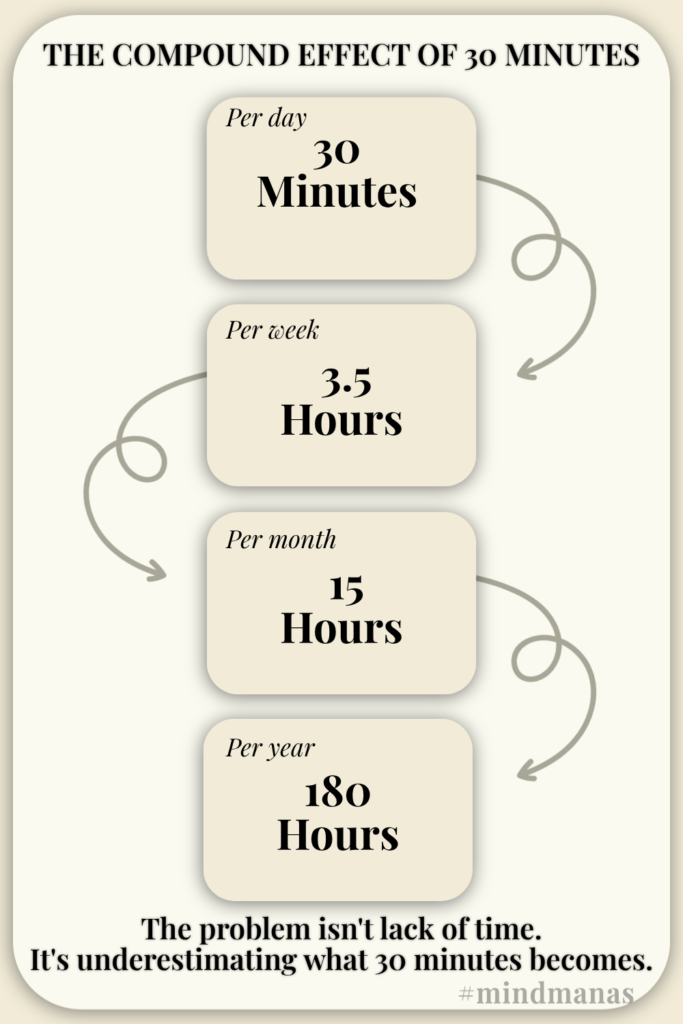
But here’s what I find even more compelling: 30 minutes a day compounds.
30 minutes daily = 3.5 hours a week = 15 hours a month = 180 hours a year.
180 hours of focused work on one thing. That is an entire skill learned. A blog built. A habit solidified. A life slowly, quietly redirected.
I lost 49 days. That’s roughly 22 hours of potential 30-minute sessions gone. That stings. But it also means starting today and being consistent for the next 49 days gets me back to where I should be and the math works the same way forward as it did backward.
The Real Problem Isn’t Time. It’s Identity.
This is the part nobody tells you.
When I didn’t write for 49 days, I slowly stopped seeing myself as someone who writes. And once you stop seeing yourself as someone who does the thing, the thing becomes foreign. Scary, even. Opening a blank document starts to feel like a confrontation.
James Clear talks about this too: identity-based habits. The most effective way to change behavior isn’t to focus on the outcome you want. It’s to focus on the kind of person you want to become and ask what would that person do today?
A person who writes every day even badly, even briefly he/she is a writer. A person who works on their goals for 30 minutes even when tired is someone who takes themselves seriously.
I want to be that person. And the only way to become that person is to act like that person before I feel like one.
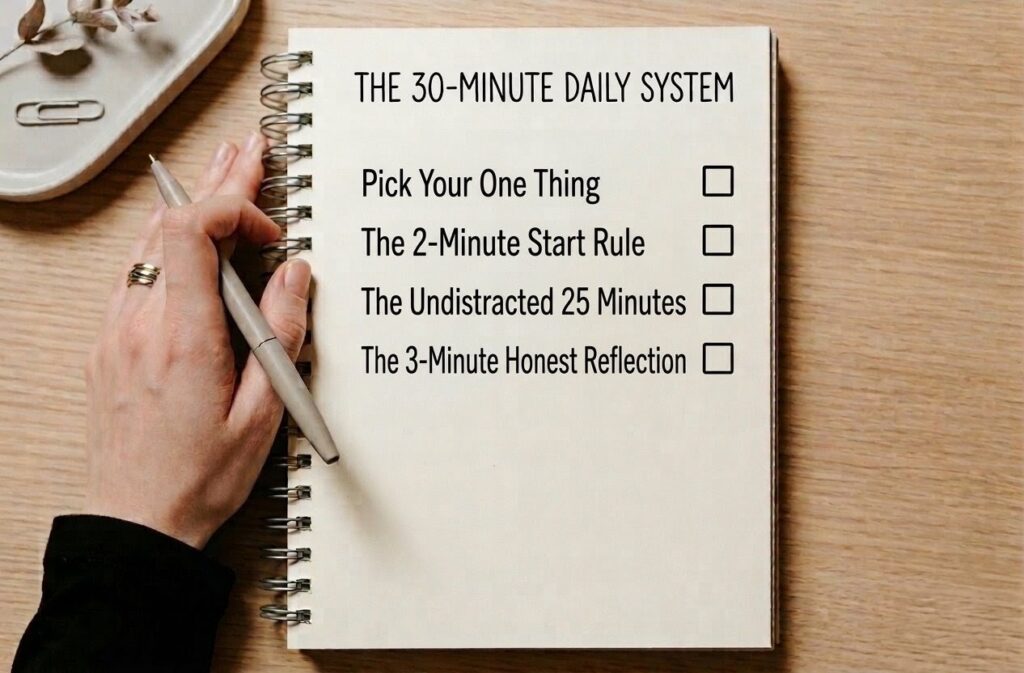
The 30-Minute Daily System That I’m Starting With (And You Can Too)
This isn’t a complicated framework. I’m not going to give you a 12-step productivity system. That’s not what changed things for me mentally. What helped was making it so small it felt almost embarrassing to skip.
Here’s exactly what I’m doing and what I’d suggest you try:
First: Pick Your One Thing (5 minutes)
Before you open anything, write down the one thing you’re working on today. Not a list. One thing. For me right now it’s to write 500 words for Mind Manas.
Research from Dominican University found that people who write down their goals are 42% more likely to achieve them. Writing it down is not symbolic. It is neurological, it activates the prefrontal cortex and signals to your brain that this is a priority, not a wish.
Second: The 2-Minute Start Rule (2 minutes)
Tell yourself you’re only going to work for 2 minutes. Open the document. Write one sentence. That’s all you’re committing to.
This comes directly from behavioral psychology specifically from BJ Fogg’s Tiny Habits research at Stanford. Making the behavior tiny removes the psychological resistance of starting. And almost always, once you start, you continue.
I used this yesterday. I told myself I’d write for 2 minutes. I wrote for 47.
Third: The Undistracted 25 (25 minutes)
Phone face down. One tab open. Nothing else.
Use a timer. 25 minutes of actual work, this is loosely based on the Pomodoro Technique developed by Francesco Cirillo, which has been validated in multiple productivity studies for its effect on focus and reducing mental fatigue.
During these 25 minutes: no checking, no editing while writing, no switching. Just produce.
Fourth: The 3-Minute Honest Reflection (3 minutes)
When the timer goes off, ask yourself three things and write the answers briefly:
- What did I actually do?
- What distracted me or slowed me down?
- What will I do differently tomorrow?
This reflection step is not optional if you want to improve over time. A 2010 study from Harvard Business School found that workers who reflected for just 15 minutes at the end of a day performed 23% better after 10 days than those who didn’t. Even 3 minutes of honest reflection activates the same learning mechanisms.
What Happens After 30 Minutes Becomes Easy
Here’s the beautiful part and this is what I want you to hold onto.
30 minutes doesn’t stay at 30 minutes for long.
Once your brain starts associating sitting down to work with the feeling of progress and momentum and it will, because that feeling is real and addictive in the best way, you will naturally start extending your sessions.
Not because you forced yourself. But because you want to.
The 30-minute block is a door. Most people never open it because it looks too small to matter. But on the other side of it is identity, momentum, and the slow building of something you’ll actually be proud of.
I’m opening that door today. Again. Even after 49 wasted days. Maybe especially because of them.
Start Today. Not Monday. Not Tomorrow. Today.
I know your version of this story might look different from mine. Maybe it’s not a blog. Maybe it’s a business idea, a fitness goal, a skill you’ve been meaning to learn, a version of yourself you’ve been meaning to become.
The details don’t matter. The math is the same. The psychology is the same. And the feeling that quiet, heavy guilt of knowing you’re not doing the thing you know you should, that’s the same too.
30 minutes. Today. One thing.
That’s how this changes.
I’ll be here writing alongside you.
If this post felt personal, it’s because it was. I’m figuring this out in real time, and Mind Manas is my honest journal of that process. If you’re on the same journey subscribe below. No spam. Just real, weekly thoughts on building a calmer, more intentional life.